A diversity scavenger hunt is one of the fastest ways to turn a room full of students into a class that actually knows each other. In fifteen minutes, kids walk around, ask questions, laugh, and discover that the classmate they’ve never talked to also speaks two languages, loves to draw, or has a grandparent who tells amazing stories.
In this guide you’ll find a free printable diversity scavenger hunt, step-by-step instructions, a list of example prompts, a short DEI scavenger hunt version for teams and staff, and 10 more diversity games for students you can use all year.
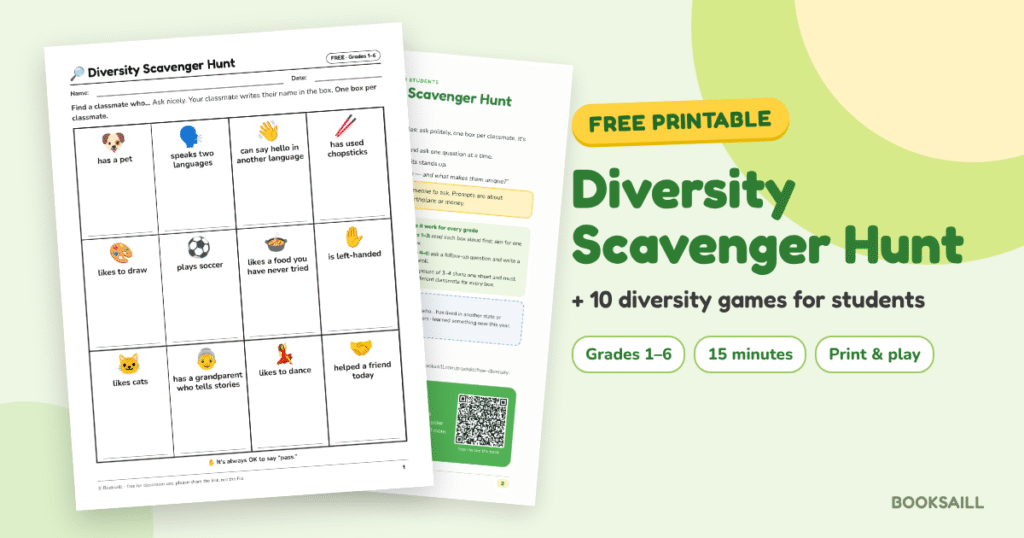
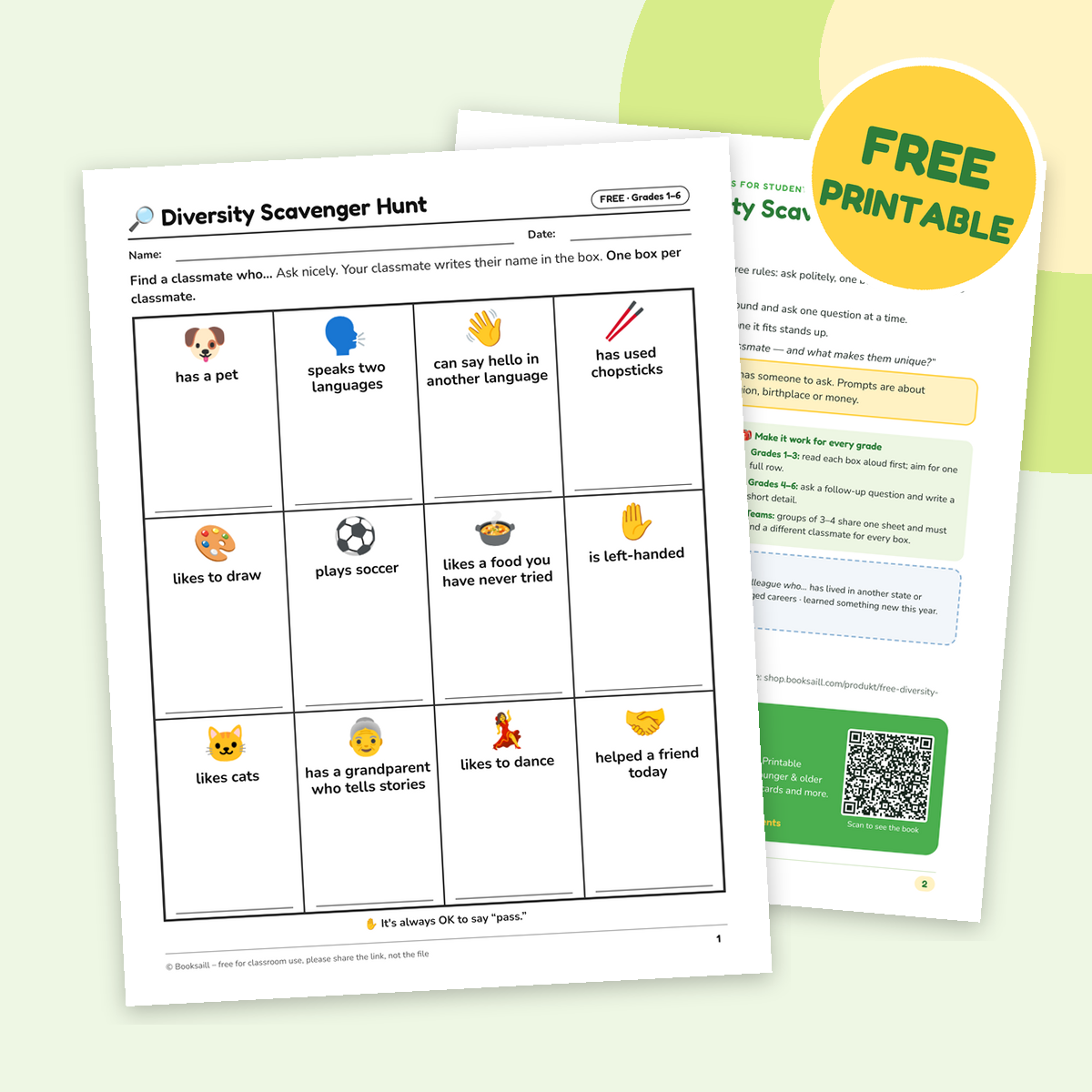
🖨️ Free download: Get the Diversity Scavenger Hunt printable — 12 picture prompts and a one-page teacher guide, ready to print.
What Is a Diversity Scavenger Hunt?
A diversity scavenger hunt is a classroom icebreaker where each student gets a sheet of “Find someone who…” prompts. Students move around the room, ask classmates questions, and collect a signature for every prompt that matches. Instead of finding objects, they find people, stories and connections.
It works because it gives every student a reason to talk to someone new — and a safe, structured way to do it. The prompts celebrate differences (languages, traditions, hobbies, places) and similarities (favorite colors, snacks, animals), so students leave with a simple, powerful idea: we’re all different, and we have a lot in common.
It’s a perfect diversity icebreaker for:
- the first week of school or a new semester
- a multicultural week, International Day or a diversity and inclusion unit
- the start of a group project, when students need to work with new partners
- the day after a long break, when the class needs to reconnect
How to Run a Diversity Scavenger Hunt
You need about 15–20 minutes, one printed sheet per student and some pencils. Here’s the routine that works in Grades 1–6.
Step 1: Print the sheets
Use picture prompts and short sentences for younger students (Grades 1–3) and written “Find someone who…” prompts for older students (Grades 4–6). Our free printable has 12 picture prompts that work for every age.
Step 2: Read the prompts together
Before anyone stands up, read the prompts aloud. Younger students can point to the pictures while you read. This takes two minutes and makes sure every child — including English learners — can join in.
Step 3: Agree on three friendly rules
- Ask politely — one question at a time.
- One box per classmate — so everyone talks to many different people.
- It’s always okay to say “pass.” Nobody has to share anything they don’t want to.
Step 4: Hunt!
Set a timer for 10–15 minutes. Students walk around and ask questions like “Do you speak more than one language?” When the answer is yes, the classmate signs that box. Older students can add a short detail, like “Spanish and English.”
Younger students can aim for one full row. Older students try to fill as many boxes as possible.
Step 5: Gather and reflect
Bring everyone into a circle. Read one prompt aloud — everyone it fits stands up. Repeat a few times and watch the groups change. Then ask the reflection question:
“What is one thing you have in common with a classmate — and one thing that makes them unique?”
That two-minute conversation is where the real learning happens.
Teacher tips
- Join in as a player. If someone is left out, they can always ask you.
- Keep prompts about experiences and interests — not appearance, religion, birthplace or family money. That way every student can find matches and nobody is singled out.
- Celebrate the results: tally how many students fit each prompt and make a quick class bar chart.
Diversity Scavenger Hunt Prompts (Example List)
Use these “Find someone who…” prompts or mix them with your own. They’re written so that every student can match several of them.
For younger students (Grades 1–3):
- has a pet
- speaks two languages
- can say hello in another language
- has used chopsticks
- likes to draw
- plays soccer
- likes a food you have never tried
- is left-handed
- likes the same color as you
- has a grandparent who tells stories
- likes to dance
- helped a friend today
For older students (Grades 4–6):
- speaks more than one language
- has visited another state or country
- has a family recipe that is special to them
- can say “hello” in three languages
- knows the story or meaning of their name
- can tell you about a family tradition
- has tried food from three different countries
- knows a song in another language
- has read a book set in another country
- knows a game from another country
- has helped a new student feel welcome
- wants to visit a country on another continent
DEI Scavenger Hunt for Teams and Staff
The same game works beautifully as a DEI scavenger hunt for adults — at a staff meeting, a PD day or a team-building session. Keep the rules and swap in workplace prompts:
Find a colleague who…
- has lived in another state or country
- speaks three or more languages
- has a family food tradition
- has a hobby nobody at work knows about
- changed careers
- has mentored someone
- learned something new this year
Give 10–15 minutes, then debrief: “What surprised you? How do our different experiences make us a stronger team?” Keep it opt-in and let people decide what they share — the goal is connection, not disclosure.
10 More Diversity Games for Students
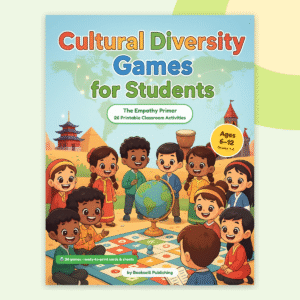
Once your class has done the scavenger hunt, keep the momentum going. These ten diversity games for students come from our classroom book Cultural Diversity Games for Students, and each takes 10–30 minutes.
1. Cultural Bingo
A fast, five-in-a-row version of “Find someone who…” — great for a 15-minute diversity icebreaker. Each student has a 5×5 card with squares like “can say thank you in two languages” or “knows a game from another country.” Classmates sign matching squares; the first full row calls out “Cultural Bingo!”
2. Festival Match-Up
Teams flip a festival card and a country card and decide whether they match — Diwali and India, Hanami and Japan, Día de los Muertos and Mexico, Songkran and Thailand. A lovely way to notice what people everywhere celebrate: light, family, harvest and new beginnings.
3. Similar But Different
Pairs fill in a Venn diagram: five things they have in common and five things that make each of them unique. It builds empathy and shows that being different isn’t better or worse — just interesting.
4. Respect Relay
Students pass a soft “Respect Ball” around a circle. Whoever holds it says one kind or respectful sentence. Simple, quick and perfect for morning meetings or SEL lessons.
5. Flag Memory Game
A classic memory game with a global twist: match each flag to its country. Add a fact to every pair (Nepal has the only flag that isn’t a rectangle!) and you’ve got a geography lesson students beg to replay.
6. Guess the Country
One student gives three clues — “This country has many volcanoes. People speak Spanish. Ancient pyramids like Chichén Itzá are here.” — and the class guesses (Mexico!). It’s also a great way to talk about how to describe places with facts, not stereotypes.
7. Voices of the World
Each group picks five languages — for example Spanish, Japanese, Swahili, Hindi and Korean — learns to say “hello” and “thank you” in each, and performs a short “World Greeting” for the class. Language becomes a bridge, not a barrier.
8. The Kindness Chain
Each student writes one act of kindness on a paper strip, and the class links the strips into a chain that grows all year. A visible, colorful reminder that small actions connect people.
9. Empathy Mirror
In pairs, one student shares an everyday feeling (“I felt proud when I finished my drawing”) and the other mirrors it back with kind words. Students experience what it feels like to be truly listened to.
10. Friendship Passport
Every student gets a small passport booklet and collects “stamps” from classmates — each one with something new they learned about that person. Keep it all term and add a stamp every time students work with a new partner.
Looking for more ideas for younger kids? Try these culture games for students on the Booksaill blog.
Get All 26 Games and 27 Printables
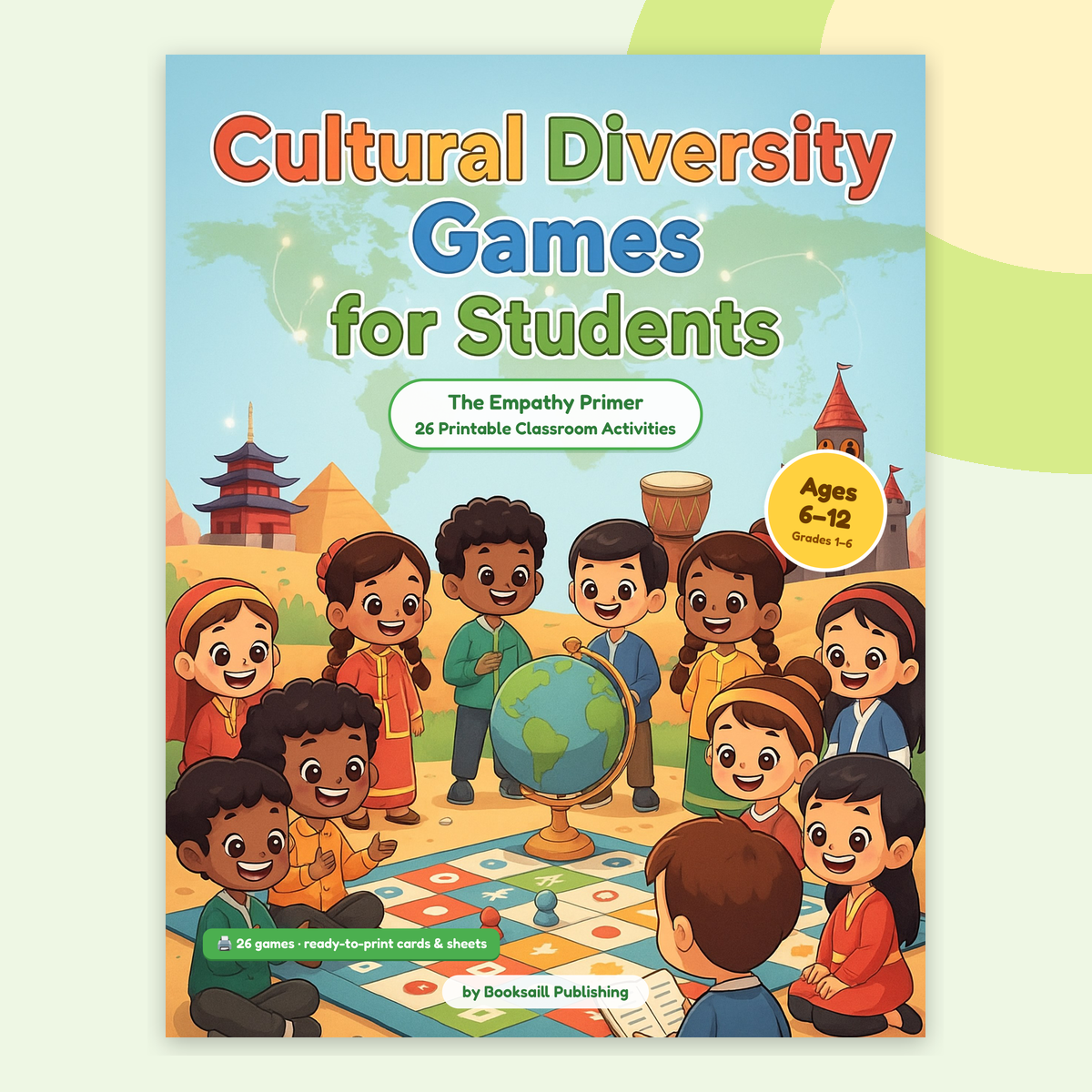
The scavenger hunt and the ten games above are just the beginning. Cultural Diversity Games for Students – The Empathy Primer is a 94-page printable book for teachers with:
- 26 classroom games for ages 6–12, each with setup, how-to-play steps, variations, a reflection question and teacher notes
- 27 printable pages — the full 25-prompt Scavenger Hunt (younger and older versions), 3 Cultural Bingo cards, 24 country cards, 20 pairs of flag cards, a foldable Friendship Passport, a certificate and more
- a Quick Start table to pick the right game in two minutes
- a separate Printables-Only PDF for easy copying
👉 See the book in the Booksaill Shop · or start with the free Diversity Scavenger Hunt printable.
FAQ
A diversity scavenger hunt is a classroom icebreaker where students use a “Find someone who…” sheet to find classmates who match prompts about languages, traditions, hobbies and experiences. It helps students meet new people and discover both differences and things they share.
Plan for 15–20 minutes: 2–3 minutes to read the prompts and rules, 10–15 minutes of hunting, and a few minutes for the circle reflection.
It works from first grade up to adults. Use picture prompts and simple sentences for Grades 1–3, written prompts with a “detail” line for Grades 4–6, and workplace prompts for a DEI scavenger hunt with staff.
Avoid prompts about appearance, religion, birthplace, immigration status or family money. Choose prompts about experiences, interests, languages and traditions so every student can participate comfortably — and always allow students to say “pass.”
Yes. For teams or staff meetings, use workplace prompts like “has lived in another state or country” or “has mentored someone,” keep it opt-in, and end with a short debrief about how different experiences make the team stronger.